




From Research to Policy: Why Evidence Matters
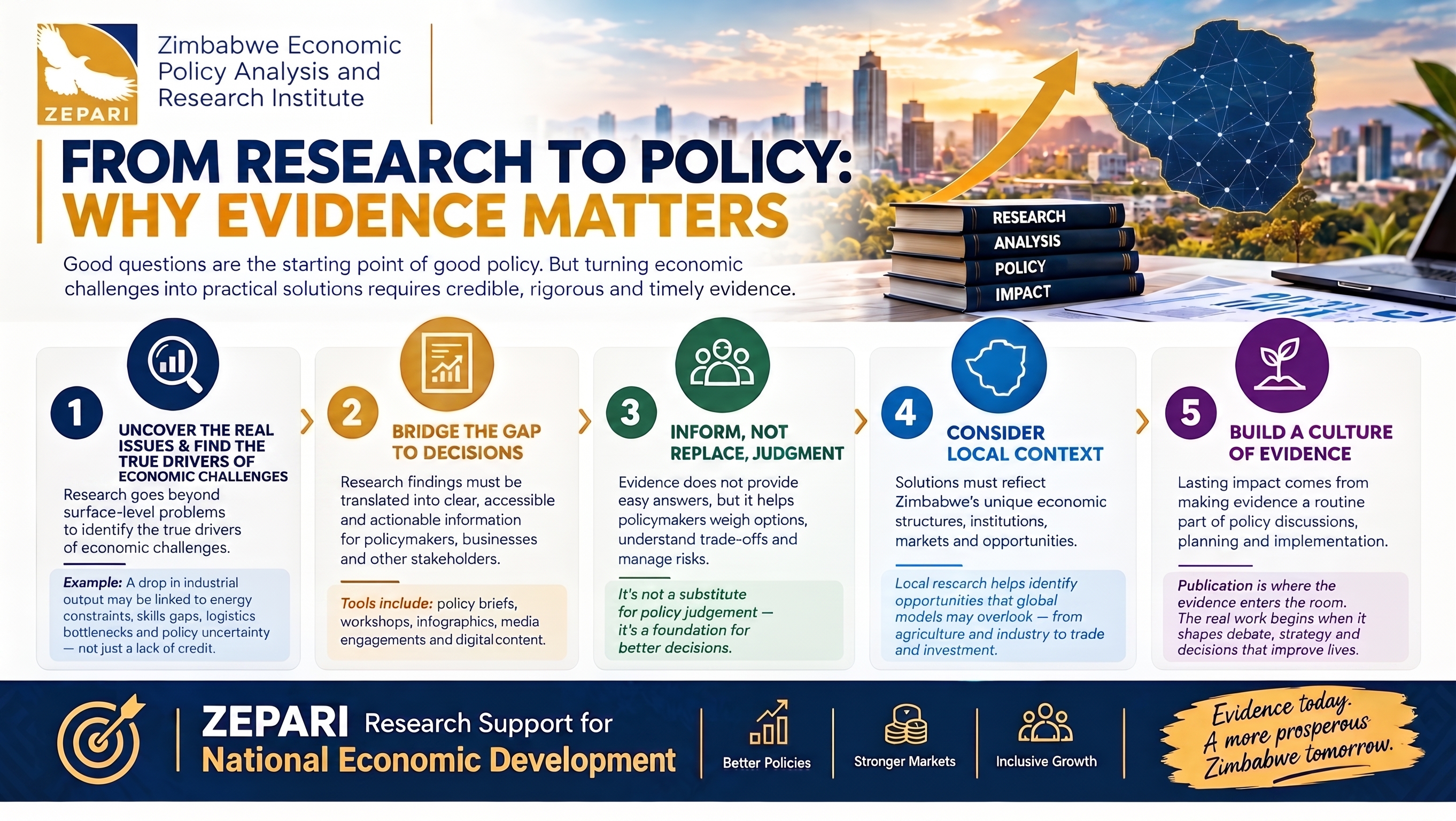
Good policy begins with good question. But good questions alone do not create jobs, stabilize markets, or raise living standards. To move the needle, questions must be answered with credible, rigorous, and timely evidence.
In the realm of economic management, the stakes could not be higher. Decisions regarding tax structures, currency management, public infrastructure spending, financial regulation, and trade tariffs carry immense consequences. A single policy adjustment made in haste or based on flawed assumptions can ripple across an entire economy, shaping daily lives of millions, from smallholder farmers in Zaka navigating fertilizer costs to industrial manufactures in Harare managing supply chains for years to come.
This is precisely why evidence matters.
For institutions like Zimbabwe Economic Policy Analysis and Research Institute (ZEPARI) research is more than an academic exercise. It is not about filling library shelves with heavy, technical reports destined to gather dust. It is about generating actionable intelligence that helps policymakers, business leaders, development partners, and civil society navigate complex economic terrain with greater clarity and confidence.
Unmasking the Real Drivers Behind Complex Challenges
Economic issues are rarely as simple as they appear on the surface. When problem arises, the obvious answer is frequently not the complete answer. Take, for example, a sudden decline in domestic manufacturing output. At first glance, it might appear to be a straightforward case of capital scarcity: if factories had access to more credit, production would rebound.
However, deeper research may reveal much more intricate web of structural bottlenecks. The decline in output could be linked to a combination of unreliable energy supply, skills gaps, logistics constrains, limited access to foreign currency, aging infrastructure, weak market demand or broader policy uncertainty that discourages long term investment.
The illusion vs the reality
Surface assumption
Low manufacturing output → Inject cheap credit → Production increases
What deeper research may reveal
Low manufacturing output → Energy constrains + skills gaps + logistics bottlenecks + financial constrains + policy uncertainty → A combination of targeted policy and structural reforms is required
Without evidence-based research, decision makers, whether in government, industry, or the development sector risk treating symptoms rather than underlying causes, deploying costly interventions that may produce disappointing results. Rigorous research allows stakeholders to move beyond educated guesses and ask the fundamental questions:
- What is actually happening across the value chain?
- Why is it happening, and who is bearing the greatest cost?
- What are the underlying structural drivers rather than immediate triggers?
- Which interventions have succeeded under similar economic conditions elsewhere?
- What are the short term and long-term costs, trade off risks, and benefits of each policy option?
Answering these questions helps ensure that policy responses address reality rather than perception.
Bridging the Gap: From Technical Findings to Decisions
Research finding creates a real-world value when it informs decisions.
Yet the journey from dataset to an enacted policy is rarely automatic. It requires deliberate translation continuous dialogue, and strategic engagement. Econometric models, regression analyses, and complex datasets are essential to maintaining technical rigor. But policymakers and other decision makers often need to understand the implications quickly: What does this mean? What should be done? Who needs to act? And what happens if nothing changes?
This is where effective research communication becomes critical.
Researchers must be able to translate complex findings into accessible and actionable knowledge through:
- Policy briefs that distil extensive research into clear messages and decision points.
- Stakeholder workshops that provide spaces for policymakers, businesses, researchers and other stakeholders to interrogate evidence together.
- Infographics and visualizations that make data, trends and relationships easier to understand.
- Public seminars and media engagements that bring research findings into wider public discussion.
- Digital content that makes research accessible beyond traditional academic and policy audiences
But the process must also work in the opposite direction. Policymakers, businesses and other stakeholders need to inform the research process by helping researchers understand practical, institutional and operational realities on the ground. This two-way exchange helps ensure that research is not only academically rigorous, but also relevant, timely and implementable.
Evidence Informs Judgement, It Does Not Replace It
Evidence based policymaking does not mean that research provides a single answer to every policy question. Policy decisions inevitably involve competing priorities, limited resources, institutional realities, political considerations and ethical choices. Credible evidence does not make these difficult choices disappear. What it does is illuminate the choices. Evidence can help policymakers understand potential consequences, assess tradeoffs, identify risks, estimate fiscal and economic impacts, and determine whether existing programs are achieving their intended objectives.
In this sense, evidence is not a substitute for policy judgement. It is what makes the judgement better informed.
Why local context matters
International economic literature provides valuable lessons, but policies cannot simply be copied and pasted from one country to another. Zimbabwe has its own economic structures, institutions, markets and historical experiences. Its informal sector dynamics, currency environment, industrial base and position within regional markets all influence how economic policies work in practice.
A policy framework that succeeds in East Asia or Western or Western Europe may therefore produce different results if applied in Zimbabwe without careful adaptation. This is why domestic research capacity matters.
Institutions such as ZEPARI help ground economic analysis in Zimbabwe's own realities. Local research can uncover challenges and opportunities that broader international models may overlook from strengthening agricultural and industrial value chains to improving productivity, supporting businesses and developing strategies that enable Zimbabwe to compete more effectively in regional and global markets.
Building a Culture of Evidence
Ultimately, evidence-based policymaking is about more than individual research projects or policy papers. It is about building a culture in which important economic decisions are consistently informed by credible data, rigorous analysis, open dialogue and continuous learning.
For Zimbabwe, strengthening this culture can contribute to more effective policies, better allocation of scarce resources and more resilient responses to changing economic conditions.
The process does not end when a research paper is published.
Publication is where evidence enters the room.
The real work continues when that evidence informs debate, challenges assumptions, shapes strategy and contributes to decisions that can improve people's lives. For research institutions, policymakers and stakeholders alike, the challenge is therefore not simply to produce more evidence. It is to ensure that the right evidence reaches the right people at the right time and ultimately helps inform better decisions.
By Decent Moyo