




Fiscal Rules and Governance in Zimbabwe: What the Research Finds
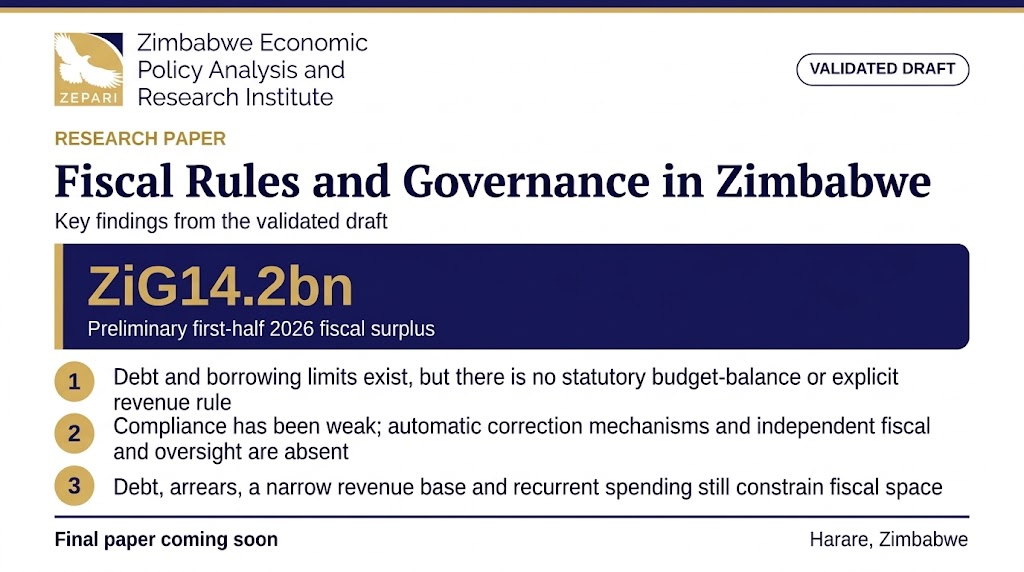
ZEPARI's research paper Fiscal Rules and Governance in Zimbabwe has been validated with stakeholders and is being finalized for publication. This article summarizes the paper's main findings, the evidence behind them, and the options it sets out for strengthening the country's fiscal framework.
Why fiscal rules matter
Fiscal rules are numerical or legal limits on key budget aggregates, such as public debt, the budget balance, expenditure or revenue. They are meant to give governments a clear anchor for fiscal decisions, make policy more predictable, and make it easier for legislators, citizens and development partners to judge whether public finances are on a sustainable path. Whether a rule achieves these aims depends not only on how it is written, but also on the institutions that monitor, enforce and report on it.
About the study
The paper assesses the design and implementation of Zimbabwe's fiscal rules. It asks what the current framework contains, how closely it has been followed, and which institutional, economic and political-economy factors help or hinder compliance.
The analysis is qualitative. It draws on budgets, fiscal and debt reports, legislation, and IMF and World Bank assessments. It reviews debt, budget-balance, expenditure and revenue rules and international practice, and compares fiscal performance and institutions in four African countries: Botswana, Namibia, Tanzania and Kenya. It also looks at enforcement, transparency, fiscal risks and public-financial-management capacity.
What the paper finds
The framework covers some areas but not others. Zimbabwe's framework includes debt and borrowing limits. It has no statutory budget-balance rule and no explicit revenue rule, so two commonly used anchors are not part of the current legal design.
- Compliance has been weak. The paper finds that adherence to the existing rules has been limited. The framework has no automatic correction mechanisms, meaning there is no predefined requirement to adjust policy when a rule is breached. It also lacks independent fiscal oversight, so there is no separate body assessing performance against the rules.
- Recent fiscal execution has improved. In 2026, fiscal execution improved, including a preliminary first-half surplus of ZiG14.2 billion. This figure is preliminary and may change as data are finalized.
- Structural pressures remain. Debt, arrears, a narrow revenue base and recurrent spending continue to constrain fiscal space, which limits how much room the government has to respond to shocks or finance priorities.
Read together, these findings point to two related but distinct questions: how public finances have performed recently, and how strong the rules and institutions behind them are.
Experience from other countries
To place Zimbabwe's experience in context, the paper compares fiscal performance and institutions in Botswana, Namibia, Tanzania and Kenya. These comparisons inform the options for reform described below. The details of each comparison will be set out in the final paper.
Options for a rules-based framework
The paper develops options for a credible, rules-based fiscal framework. These include:
- An independent fiscal council and a legally defined budget-balance rule. An independent body can assess budgets and compliance independently of the executive, while a statutory balance rule would fill the current gap in the framework.
- Stronger debt, expenditure and revenue rules within a coherent medium-term framework. This would help the rules work together rather than as separate limits.
- Commitment controls, arrears management, transparency and corrective action. These tools support enforcement and help keep spending within agreed limits.
- Clearly defined escape clauses for major shocks, and a credible return-to-rule path. Escape clauses set out in advance when rules may be temporarily relaxed, and a return path sets out how and when the government will return to compliance.
Next steps
The paper is being finalized using feedback from the validation process and will be published on this website. Follow ZEPARI on LinkedIn for the release.
By Decent Moyo